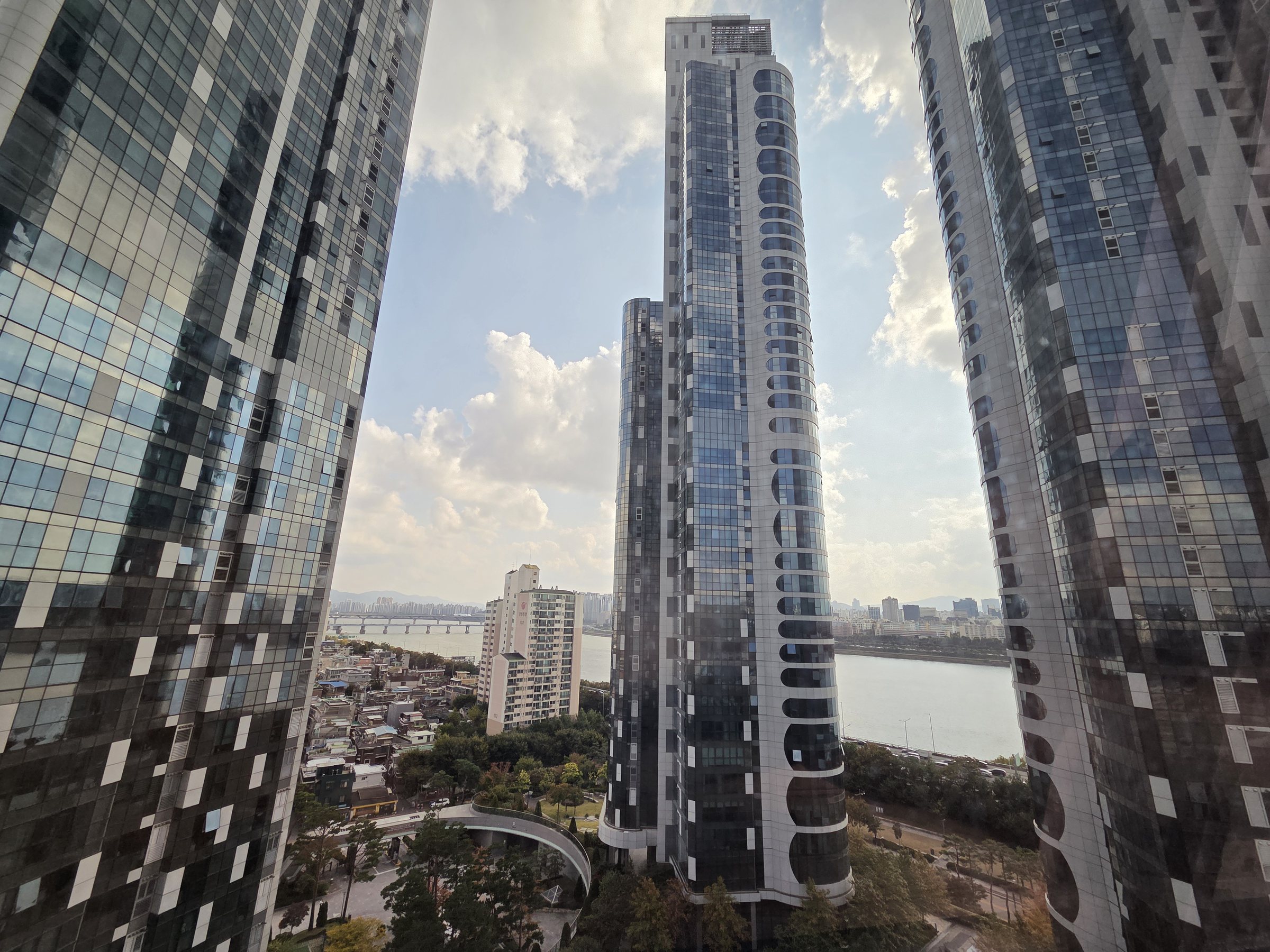
Quantitative research & trading · Trimage, Seongsu-dong, Seoul · 37.5442° N, 127.0450° E
We trade only what we failed to refute.
StreetSmart Research is a small quantitative trading firm working from the Han River in Seongsu. We declare every hypothesis before we see its result, test it against a benchmark that holds the same exposure, and keep the rejections in a ledger. Most ideas do not survive. We trade the ones that do.
Company
A research desk that happens to trade
We study short- and medium-horizon structure in crypto perpetual futures, leveraged ETFs and their swaps, and the cross-section of liquid altcoins. The work is organised like a laboratory: one problem framework, a registry of strategy families, and gates that every idea passes in the same order.
Hypotheses with a price on them
Each idea is stated with its minimum detectable effect and the trial count of its family before any data is touched.
Exposure-matched, out of sample
Purged cross-validation, placebo signals, and the expected maximum Sharpe of all trials run so far.
Costs measured, not assumed
Fee, half-spread and square-root impact, calibrated on our own fills to within half a basis point.
Shadow by default
Every strategy runs on a shadow book first. Reconciliation, alerts and a kill path stay on around the clock.
Problems we study
Six questions, and where each one stands
These are the problems we return to most often. The mathematics is the standard literature, restated in our notation. The verdicts are ours.
Where does a Sharpe ratio come from?
We reduce every candidate to hit rate, magnitude, cost and breadth. If it cannot say which term it improves, it is not a strategy yet.

Is the best backtest just the luckiest?
Searching produces winners by construction. A discovery has to beat the maximum that noise alone would deliver over the same number of trials.

Does the price revert, and how fast?
Mean reversion is only tradable if its half-life is shorter than a random walk’s would appear to be, after costs.

What will this trade actually cost?
Spread estimators built for daily equities measure volatility in crypto. Impact estimators built on signed flow measure cost.

Is it skill, or just more exposure?
Sizing rules, kill switches and regime gates change how much is held. A benchmark that holds the same average exposure removes that effect.

Can a crash be seen coming after a run-up?
We forecast the probability of a five-day drawdown in the worst decile, from volatility alone and with every run-up signal we have.
Method
Seven gates, in a fixed order
An idea moves to the next gate only with a written record of the last one. Nothing skips ahead, and a rejected design is never re-run on the same data to rescue it.
Principles
Three rules we do not bend
Exposure-matched benchmarks
A strategy is compared with a passive position of the same average size. Lower drawdown from holding less is not an edge.
The system is the unit
A component is adopted for what it does to the whole book: change in Sharpe, realised ratio, losses avoided, hypotheses blocked.
Second-order evidence
Year-by-year stability, the equity curve and liquidity-conditioned IC are reported every time, even when the headline passes.
Technology & controls
Built so that the default is to do nothing
Our terminal separates the interface from a headless core, stores every quote and fill locally, and runs each algorithm on a shadow book until it is deliberately promoted.
Exchange keys are stored with owner-only permissions and used only for signing. They are never displayed or transmitted.
The live layer refuses to send until the CIO arms it, with per-order, per-position and daily-loss limits.
An explicit live flag on the order path. A single command cancels everything and stops every algorithm.
Instruments
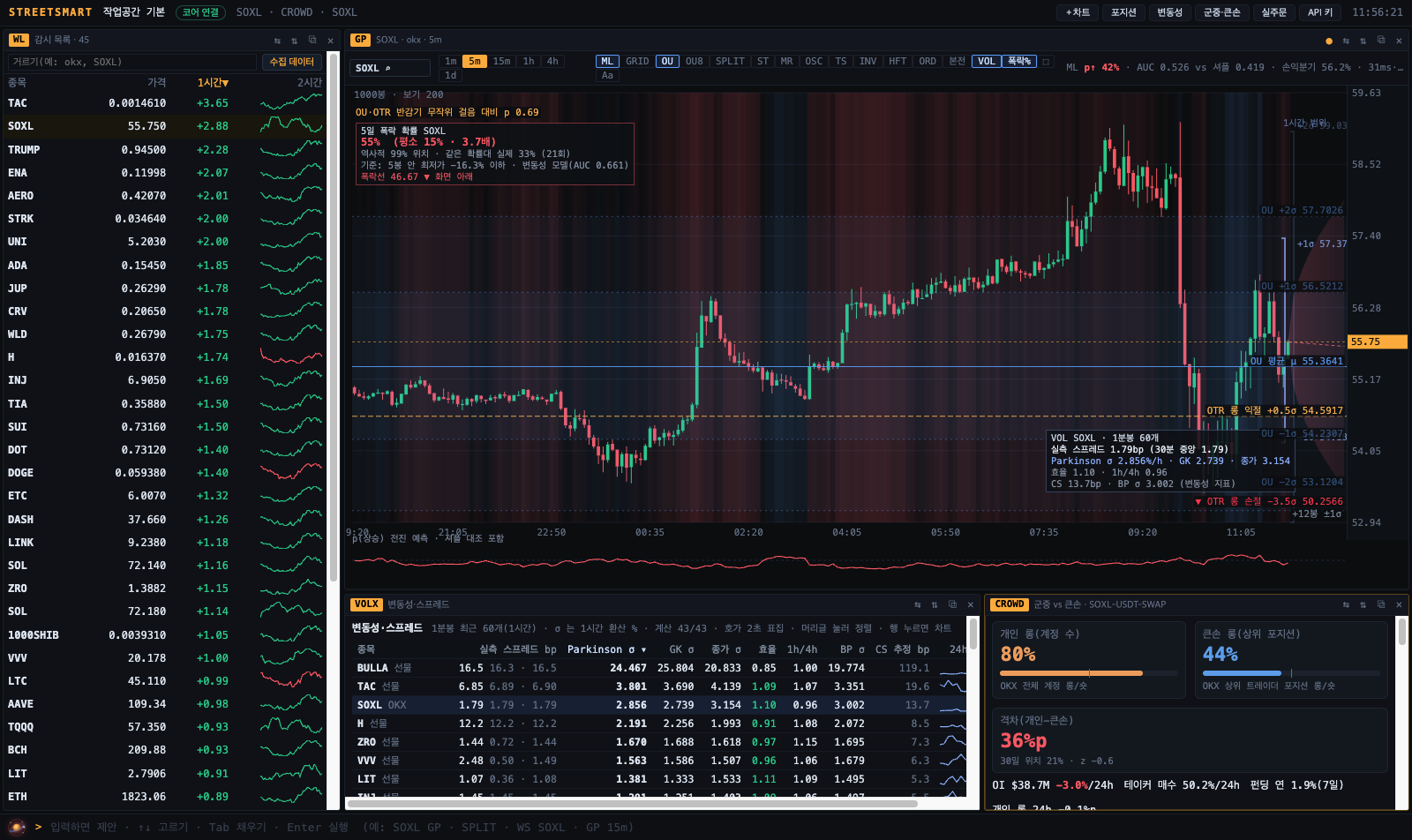
The terminal we actually trade from
Our own trading terminal: the screen and the engine are separate programs, and the overlays on the chart are the studies in our compendium, turned into instruments.
Publication · Vol. I
A Compendium of Results, Refuted and Otherwise
Results from mathematical finance, each restated as a definition or proposition, followed by a remark and its empirical status on our own data.
Contact
By introduction
We are a proprietary desk and do not take outside capital. We are glad to compare notes on methods, especially on results that failed for us and may work for you.
Read the research compendium© 2026 StreetSmart Research. This page describes research methods and is not an offer, solicitation or investment advice. Past and simulated results do not indicate future returns. Live model performance is deliberately not disclosed. Skyline illustration drawn in code; not a photograph. Privacy

